

'%3E%3Cpath%20stroke='%23000'%20stroke-width='4'%20d='m-35-37-13%2020m5%203%2013-20m5%203-13%2020m63%2042%206-9m1-2%206-9m5%203-6%209m-1%202-6%209m5%203%206-9m1-2%206-9m-96%200%2013%2020m5-3-6-9m-1-2-6-9m5-3%2013%2020m63-42-6-9m-1-2-6-9m5-3%2013%2020m5-3-6-9m-1-2-6-9'/%3E%3Ccircle%20r='24'%20fill='%23cd2e3a'/%3E%3Cpath%20fill='%230047a0'%20d='M0%200a12%2012%200%201%201%2020%2013%2024%2024%200%201%201-40-26A12%2012%200%201%200%200%200'/%3E%3C/g%3E%3C/svg%3E)


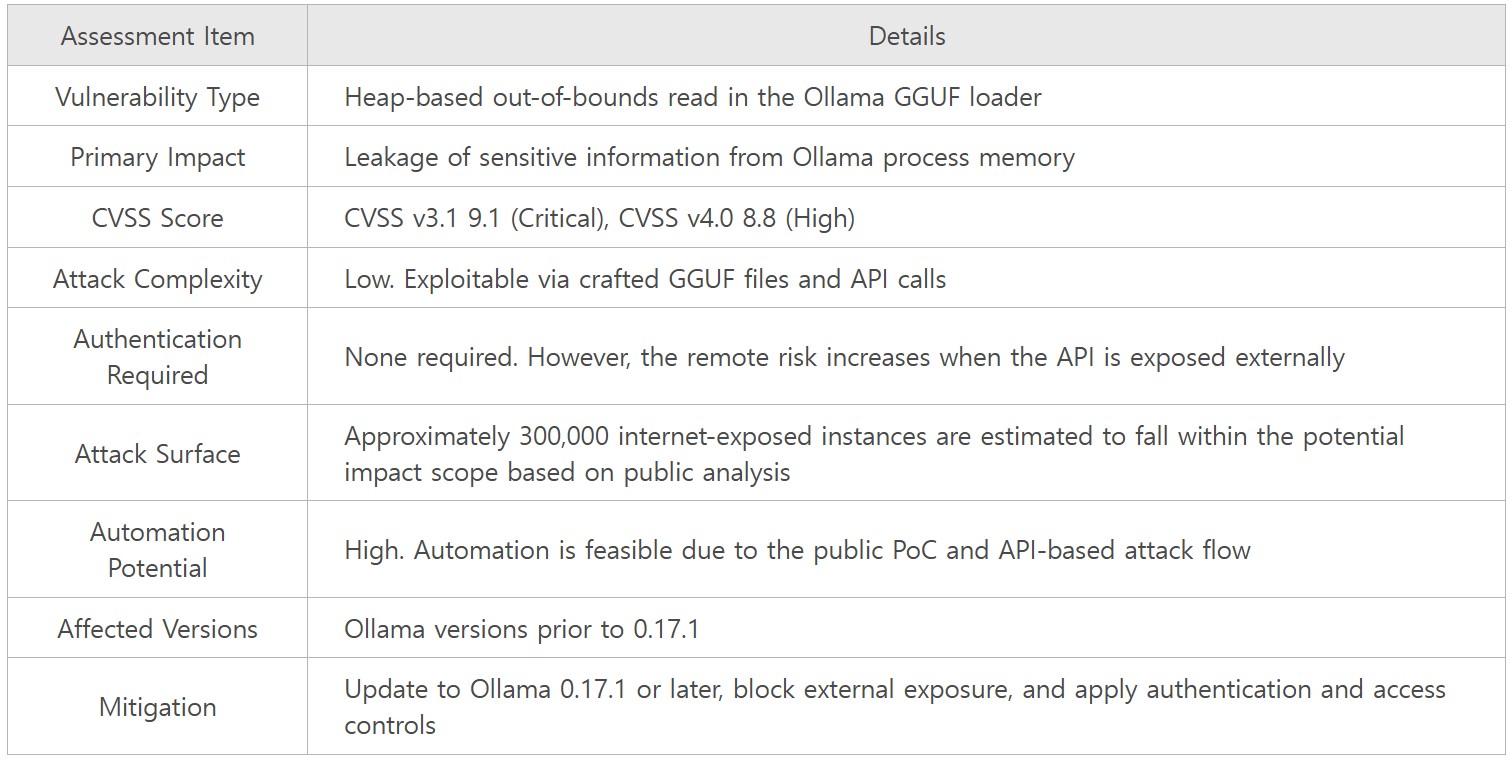
CVE-2026-7482 is a high-risk vulnerability in Ollama that occurs during GGUF model file processing.
The issue is caused by a heap-based out-of-bounds read, which may allow unintended memory data from the Ollama server process to be exposed.
If exploited, an attacker could submit a crafted GGUF model file and potentially leak sensitive information such as API keys, environment variables,
system prompts, internal instructions, and user conversation data. The risk is higher when Ollama APIs such as /api/create and /api/push are exposed
without proper access control.
This vulnerability affects Ollama versions prior to 0.17.1. Affected environments should upgrade to Ollama 0.17.1 or later, restrict external API access,
and review exposed instances for suspicious model creation or data transfer activity.
locally and in server environments. This flaw is classified as a Heap-based Out-of-Bounds Read, which occurs during the process of loading and parsing
GGUF model files within Ollama.
Root Cause
The core vulnerability stems from insufficient validation of GGUF file metadata and inadequate memory boundary checks.
Ollama fails to cross-verify the tensor offset and size information declared in the GGUF file against the actual file size.
Consequently, this allows the system to attempt to read data outside the file's legitimate boundaries.
When the model processing and quantization logic references the buffer—blindly trusting the declared metadata—it reads beyond
the boundaries of the allocated heap buffer into other memory spaces within the server process.
This results in a Heap-based Out-of-Bounds Read.
Technical analyses indicate that this flaw specifically occurs within the WriteTo() function during the GGUF loading and quantization processes.
Exfiltrated Data Targets
Server memory data exposed through the out-of bounds read is incorporated into the resulting model artifacts. By pushing these artifacts to an external registry,
attackers can exfiltrate highly sensitive information. Publicly available analyses highlight that the following types of data are at risk of exposure:
System Control Information
Critical environment variables, including API keys, authentication tokens, and database connection strings.
AI Model Assets
System prompts, internal instructions, and security policy configurations.
User Data
Prompts, chat histories, and outputs from external tool integrations belonging to other users.
Core Asset and Sensitive Data Leakage
A successful exploitation allows attackers to exfiltrate critical information residing in the server's memory. This includes:
This vulnerability highlights the severe operational risks of Shadow AI (unmonitored AI deployments).
If an organization fails to track the existence, network exposure, or patch status of its Ollama instances, compromised servers will serve as an easy entry point for threat actors.
Furthermore, exfiltrated credentials or compromised server infrastructure can be weaponized for secondary attacks, including:
Immediate Patch Management
Network Isolation and Access Control
Incident Response and Post-Exposure Remediation
If an Ollama instance was previously exposed to the public internet, organizations should operate under the assumption of compromise and execute the following post-incident measures:
and highly sensitive information, including system prompts, third-party API keys, and user chat histories.
While implementing Web Application Firewall (WAF) rules can help detect or block certain malicious requests,
these measures serve only as temporary mitigations and do not address the root cause.
Temporary WAF Mitigation Rules
Organizations can deploy the following WAF detection rules as a stopgap measure to reduce immediate risk:
Strategic Recommendation Moving forward, when deploying local AI or internal LLM infrastructure, organizations must integrate a defense-in-depth architecture from the initial design phase.
This includes mandatory authentication, strict access control, network segmentation, WAF deployment, and comprehensive log monitoring.
Adopting these measures will eliminate security blind spots caused by Shadow AI deployments and ensure that enterprise AI infrastructure is securely managed under
the principles of Zero Trust.
The issue is caused by a heap-based out-of-bounds read, which may allow unintended memory data from the Ollama server process to be exposed.
If exploited, an attacker could submit a crafted GGUF model file and potentially leak sensitive information such as API keys, environment variables,
system prompts, internal instructions, and user conversation data. The risk is higher when Ollama APIs such as /api/create and /api/push are exposed
without proper access control.
This vulnerability affects Ollama versions prior to 0.17.1. Affected environments should upgrade to Ollama 0.17.1 or later, restrict external API access,
and review exposed instances for suspicious model creation or data transfer activity.
1. Overview
CVE-2026-7482 is a high-severity vulnerability discovered in Ollama, an open-source platform that enables users to run Large Language Models (LLMs)locally and in server environments. This flaw is classified as a Heap-based Out-of-Bounds Read, which occurs during the process of loading and parsing
GGUF model files within Ollama.
- Attack Vector & Impact An attacker can trigger this vulnerability by uploading a specially crafted, malicious GGUF file to a vulnerable Ollama server. Successful exploitation allows unauthorized reading of the server process memory space. This can lead to the exposure of highly sensitive information, including environment variables, integrated API keys, system prompts, and chat histories of other users.
- Exposure Risks In certain Ollama deployment environments, APIs associated with model creation and uploading (such as /api/create and /api/push) may be exposed to the internet without proper authentication. In such scenarios, an attacker can cause severe data leakage simply by submitting a manipulated model file.
- Affected Versions & Mitigation This vulnerability affects all Ollama versions prior to 0.17.1. Vendors and security advisories strongly recommend that users immediately upgrade to version 0.17.1 or higher, where the patch has been applied.
2. Root Cause Analysis and Attack Vector
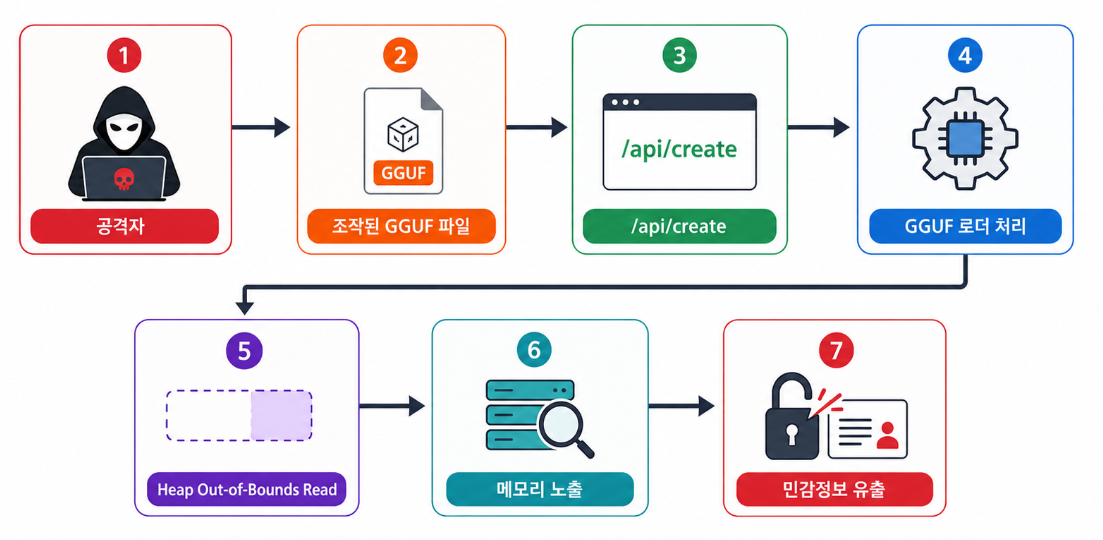
Attack Flow and Accessibility- Initial Access: CVE-2026-7482 can be exploited via exposed Ollama APIs without requiring any prior authentication. Remote attackers can easily access the vulnerability if the Ollama server is exposed to an external network or bound to 0.0.0.0.
- Exploitation Process: The attack begins when a perpetrator submits a malicious GGUF file containing manipulated metadata to the server. The attacker then requests model creation based on this file, triggering an out-of-bounds memory read within the server process.
- Exfiltration Mechanism: The leaked memory data is captured and embedded into the newly generated model artifact. The attacker can then exploit Ollama's model registry push feature to exfiltrate this sensitive data to an external server or a registry under their control.
Root Cause
The core vulnerability stems from insufficient validation of GGUF file metadata and inadequate memory boundary checks.
Ollama fails to cross-verify the tensor offset and size information declared in the GGUF file against the actual file size.
Consequently, this allows the system to attempt to read data outside the file's legitimate boundaries.
When the model processing and quantization logic references the buffer—blindly trusting the declared metadata—it reads beyond
the boundaries of the allocated heap buffer into other memory spaces within the server process.
This results in a Heap-based Out-of-Bounds Read.
Technical analyses indicate that this flaw specifically occurs within the WriteTo() function during the GGUF loading and quantization processes.
Exfiltrated Data Targets
Server memory data exposed through the out-of bounds read is incorporated into the resulting model artifacts. By pushing these artifacts to an external registry,
attackers can exfiltrate highly sensitive information. Publicly available analyses highlight that the following types of data are at risk of exposure:
System Control Information
Critical environment variables, including API keys, authentication tokens, and database connection strings.
AI Model Assets
System prompts, internal instructions, and security policy configurations.
User Data
Prompts, chat histories, and outputs from external tool integrations belonging to other users.
3. Impact and Business Implications
Threat Scale and Attack Indicators- Global Exposure: Recent security research indicates that a significant number of Ollama servers worldwide are currently exposed to the internet.
- High-Severity Risk: CVE-2026-7482 is a Critical-rated vulnerability with a CVSS score of 9.1. Because it can be exploited without authentication, the risk is exceptionally high for any publicly exposed environment.
- Exploitation Potential: With Proof-of-Concept (PoC) exploits publicly available, there is a severe risk of automated scanning and large-scale, opportunistic attacks.
Core Asset and Sensitive Data Leakage
A successful exploitation allows attackers to exfiltrate critical information residing in the server's memory. This includes:
- Environment Variables: API keys, authentication tokens, and database connection strings.
- Model Assets: System prompts and internal security rules.
- User Data: User prompts and chat histories.
Extended Risk: In environments integrated with external tools or internal document retrieval systems (e.g., RAG), core corporate assets—such as proprietary source code, customer records, and confidential legal contracts—are also highly vulnerable to exposure.Strategic Threats: Shadow AI and Secondary Attacks
This vulnerability highlights the severe operational risks of Shadow AI (unmonitored AI deployments).
If an organization fails to track the existence, network exposure, or patch status of its Ollama instances, compromised servers will serve as an easy entry point for threat actors.
Furthermore, exfiltrated credentials or compromised server infrastructure can be weaponized for secondary attacks, including:
- Unauthorized lateral movement into internal corporate networks.
- GPU resource hijacking.
- Unauthorized cryptocurrency mining.
- Establishing malicious proxy nodes.
4. Mitigation and Countermeasures
To effectively mitigate the risks associated with CVE-2026-7482, organizations must implement the following multi-layered defense strategy:Immediate Patch Management
- Upgrade Ollama: Since the flaw affects all versions below 0.17.1, the primary and most critical action is to immediately upgrade all instances to Ollama version 0.17.1 or higher.
Network Isolation and Access Control
- Restrict Internet Exposure: Ensure Ollama servers are not directly accessible from the public internet. Restrict operations to local or internal networks (localhost or internal private subnets).
- Implement Authentication: If external access is required, restrict connection capabilities exclusively to authenticated users using Firewalls, Virtual Private Networks (VPNs), or Reverse Proxies.
- API Endpoints Audit: Specifically audit endpoints tied to model creation and distribution (e.g., /api/create and /api/push) to guarantee they are locked down and cannot be accessed without proper authorization.
Incident Response and Post-Exposure Remediation
If an Ollama instance was previously exposed to the public internet, organizations should operate under the assumption of compromise and execute the following post-incident measures:
- Credential Rotation: Revoke and reissue all sensitive credentials that may have resided in the server's environment variables or memory, including third-party API keys, authentication tokens, and database passwords.
- Log Analysis: Thoroughly inspect server access and application logs for indicators of compromise (IoCs), such as anomalous model creation requests, unauthorized model push activities, or suspicious outbound network traffic to unrecognized external servers.
5. Conclusion
CVE-2026-7482 is more than a mere software bug; it is a critical vulnerability capable of exposing an enterprise's core AI assetsand highly sensitive information, including system prompts, third-party API keys, and user chat histories.
While implementing Web Application Firewall (WAF) rules can help detect or block certain malicious requests,
these measures serve only as temporary mitigations and do not address the root cause.
Temporary WAF Mitigation Rules
Organizations can deploy the following WAF detection rules as a stopgap measure to reduce immediate risk:
- Endpoint Restriction: Block or alert on any incoming traffic from external IP addresses attempting to access the /api/create or /api/push endpoints.
- Payload Inspection: Inspect request bodies for GGUF model files or parameters associated with model creation.
- Anomaly Detection: Flag or drop requests containing abnormally large payloads or excessive model metadata fields.
- Authentication Validation: Drop any API calls to model creation or upload endpoints that lack proper authorization headers.
- Rate Limiting: Throttle or block repetitive model creation requests initiated within a short time frame.
- Exfiltration Prevention: Detect and block attempts to push models to unrecognized or external registry addresses.
Important: Because WAF rules can often be bypassed by sophisticated attackers, upgrading the Ollama operational environment to
version 0.17.1 or higher remains the highest priority and definitive solution.
Additionally, instances must be isolated within internal networks, and all primary credentials—such as API keys, tokens,
and database passwords—should be completely rotated to mitigate the risk of prior data exposure.
Strategic Recommendation Moving forward, when deploying local AI or internal LLM infrastructure, organizations must integrate a defense-in-depth architecture from the initial design phase.
This includes mandatory authentication, strict access control, network segmentation, WAF deployment, and comprehensive log monitoring.
Adopting these measures will eliminate security blind spots caused by Shadow AI deployments and ensure that enterprise AI infrastructure is securely managed under
the principles of Zero Trust.
5. References
- https://nvd.nist.gov/vuln/detail/CVE-2026-7482
- https://www.sentinelone.com/ko/vulnerability-database/cve-2026-7482/
- https://www.boho.or.kr/kr/bbs/view.do?searchCnd=&bbsId=B0000133&searchWrd=&menuNo=205020&pageIndex=1&categoryCode=&nttId=72047
- https://access.redhat.com/security/cve/cve-2026-7482
- https://www.cyera.com/research/bleeding-llama-critical-unauthenticated-memory-leak-in-ollama
- https://www.akto.io/blog/bleeding-llama-300k-servers-at-risk-response-guide
- https://threatroad.substack.com/p/bleeding-llama
- https://www.tenable.com/cve/CVE-2026-7482
- https://thehackernews.com/2026/05/ollama-out-of-bounds-read-vulnerability.html
- https://www.securityweek.com/critical-bug-could-expose-300000-ollama-deployments-to-information-theft/