


[October 2025 Web Attack Trend Analysis]
1. Weekly Web Attack Trend Analysis
By analyzing weekly web attack trends, it is possible to identify specific periods during which web attacks were heavily concentrated. This insight can be used to establish proactive prevention and response strategies in preparation for periods with frequent attack activity.
The graph below visualizes the number of web attacks detected by AIWAF on a weekly basis during October 2025.
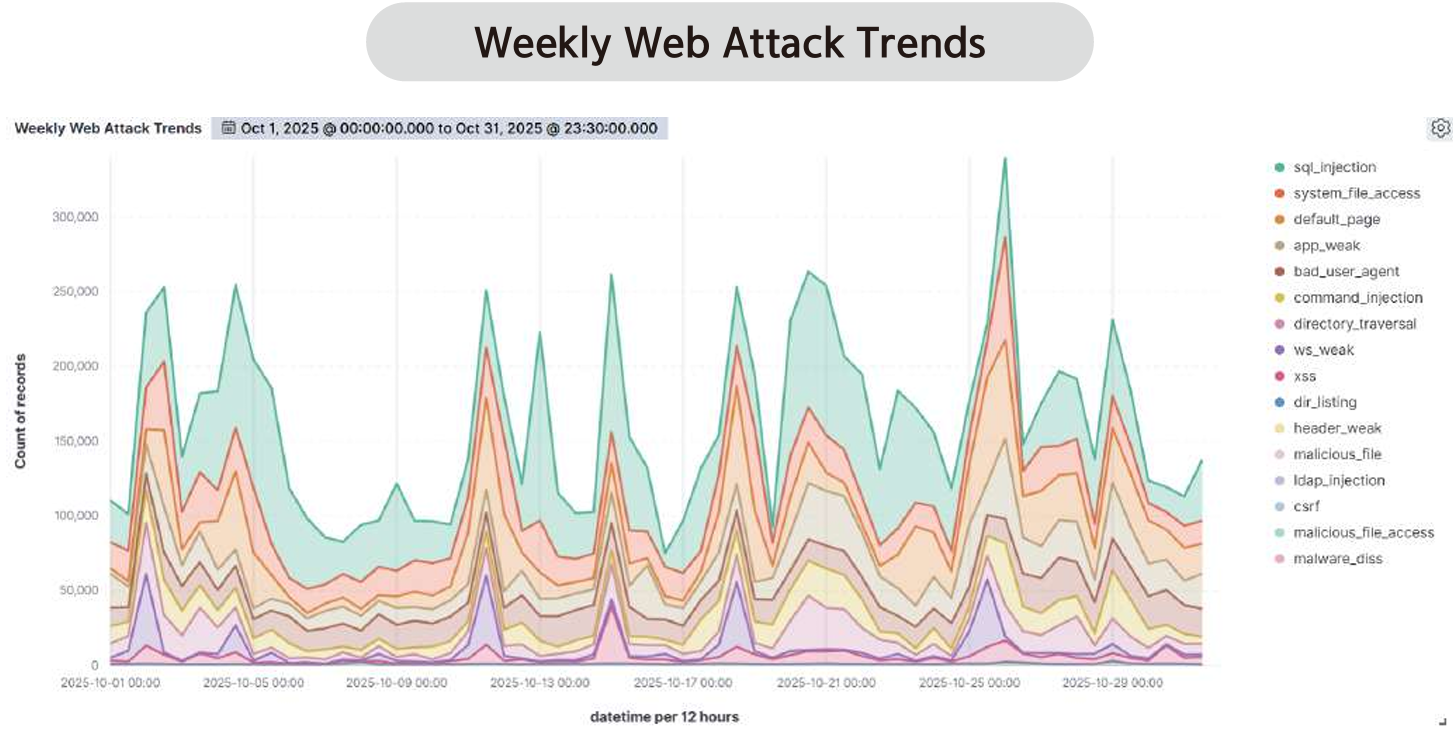
An analysis of the data detected by AIWAF during October 2025 showed that an average of more than 370,000 web attacks were detected per day. This figure reflects a significant increase compared to the previous month, demonstrating that threats targeting web servers continue to grow in sophistication.
In addition, the frequency of attacks was higher on weekends (Saturday and Sunday) than on weekdays, which can be interpreted as a strategic approach targeting periods when web server usage is lower outside of business hours.
In particular, October 26 recorded the highest concentration of web attacks during the entire month, with System File Access attacks accounting for the largest proportion of detections on that day.
System File Access represents a serious security threat, similar to SQL Injection, which aims to manipulate databases for privilege escalation or information leakage. Through this method, attackers may attempt to read sensitive server configuration files (such as /etc/passwd), application configuration files, log files, or arbitrary files resulting in information disclosure and in some cases may gain write or execution privileges to escalate system-level permissions. Due to these characteristics, organizations must pay special attention to protecting internal configuration data and user information.
AIWAF also classifies System File Access as a high-risk attack type, with multiple detection patterns in place for it. These findings highlight the need for continuous monitoring and precise response strategies for major web attack types, including system file access vulnerabilities. They will also serve as an important reference for establishing future detection and mitigation policies.
2. Web Attack Trends by Attack Type
By analyzing web attack trends by type based on detection logs, it is possible to systematically identify which types of attacks occurred most frequently during the month. Such analysis goes beyond simple statistics and serves as a key foundation for establishing organizational security policies and formalizing response frameworks.
An analysis of the detection logs collected by AIWAF during October 2025 revealed that various types of web attacks were detected, with certain attack categories displaying distinct patterns such as being heavily concentrated during specific periods or accounting for a significant proportion of the overall attack volume.
In particular, classic yet still highly threatening attack types such as SQL Injection and System File Access ranked among the most prominent. These attacks are typically executed repeatedly, often through automated tools or botnets.
The graph below visualizes the distribution of web attack types detected by AIWAF in October 2025.
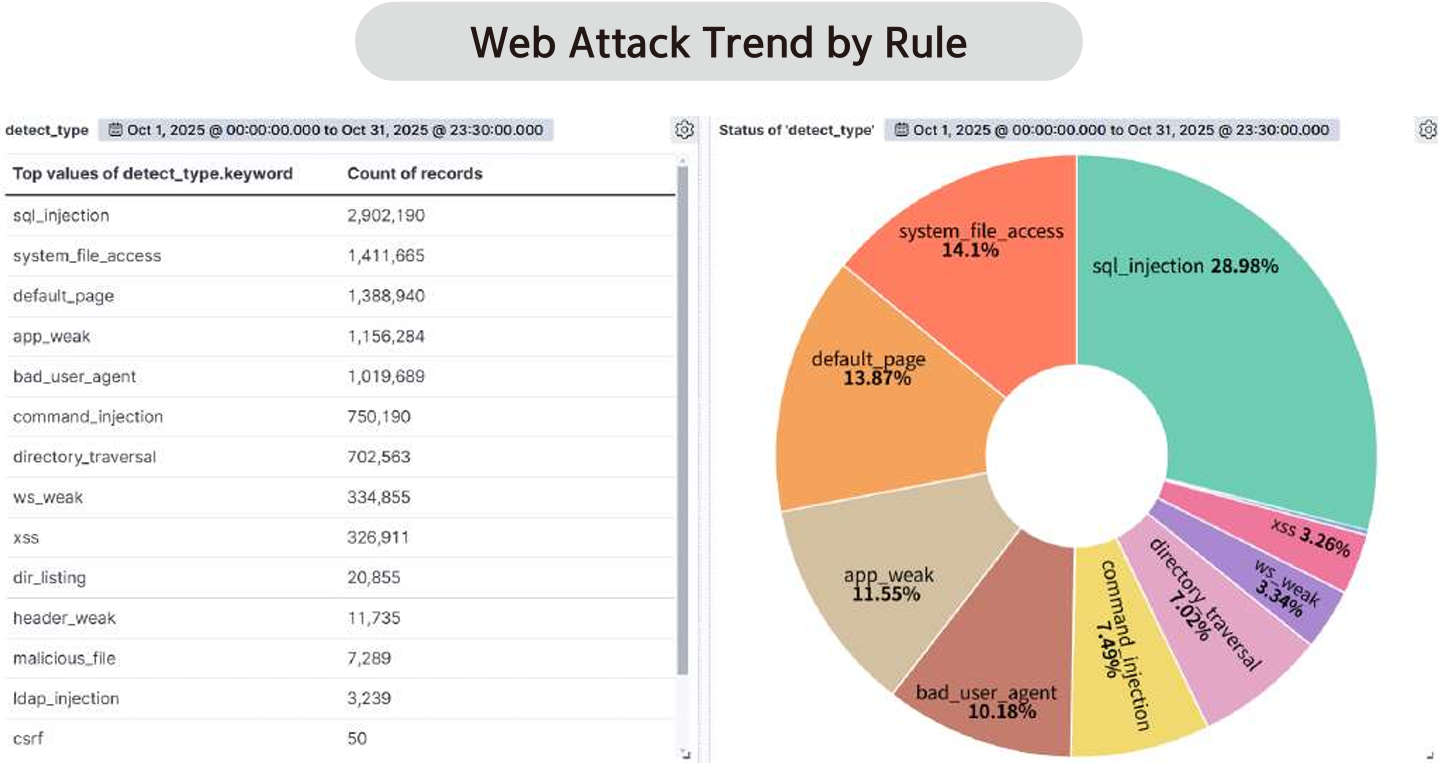
According to the statistics of web attack types detected by AIWAF during October 2025, SQL Injection accounted for 28.98% of all detections, marking the highest proportion. This was followed by System File Access (14.1%), Default Page (13.87%), App Weak (11.55%), and Bad User Agent (10.08%).
These results indicate the need for more precise countermeasures and proactive preventive actions for specific attack types.
First, SQL Injection is a highly critical attack type that consistently ranks near the top of the OWASP Top 10, and its techniques continue to evolve in diverse ways. This attack typically occurs when values supplied via user input are incorporated directly into SQL queries and executed. Attackers exploit this to perform abnormal authentication bypasses, enumerate database structures, and steal sensitive data. Systems that use dynamic queries or lack sufficient input validation are particularly vulnerable to such attacks.
The second most prevalent type, System File Access (14.1%), refers to attempts by attackers to exploit vulnerabilities in web applications to gain unauthorized access to internal system files and directories or to manipulate arbitrary files. Such attacks can arise from issues such as improper web server configuration, insufficient access controls, or failures in directory path validation. If successful, they may lead to privilege escalation or the installation of backdoors.
The third most prevalent type, Default Page (13.87%), targets pages that remain in their default state after installation or system message pages. These pages often expose information about the type and configuration of system software during the reconnaissance phase, which can be leveraged for follow-up attacks. While generally passive, this attack type is frequently scanned in large volumes by automated tools, making early detection and response essential.
The fourth most prevalent type, App Weakness (11.55%), targets inherent security flaws within applications, such as weak authentication, session management vulnerabilities, or configuration errors. Notably, detections of authentication bypass attempts and API abuse in cloud-based SaaS systems and API-driven services have been increasing, indicating that these trends may influence future cloud security policy development.
The fifth most prevalent type, Bad User Agent (10.18%), focuses on requests that use malicious or abnormal User-Agent strings to probe systems or masquerade as automated scanners or crawlers. During the reconnaissance phase, abnormal User-Agent strings can reveal information about the tools or scanning objectives used by attackers (e.g., vulnerability scanning, crawling, scraping), providing clues for subsequent attacks. This type of traffic often involves detection evasion techniques such as impersonating legitimate browsers or using known malicious signatures and appears in large-scale automated patterns, meaning it cannot be regarded as purely passive. Because it frequently originates from automated scanners in high volumes, early detection and blocking are critically important.
The Web Attack Trend Report provides the latest web vulnerability analyses, industry-specific attack patterns, and key CVE-based vulnerability information, all based on processed data from the AI/ML-powered threat intelligence platform AILabs.
Subscribe to receive the full monthly Web Attack Trend Report!
[ Subscribe → ]