

'%3E%3Cpath%20stroke='%23000'%20stroke-width='4'%20d='m-35-37-13%2020m5%203%2013-20m5%203-13%2020m63%2042%206-9m1-2%206-9m5%203-6%209m-1%202-6%209m5%203%206-9m1-2%206-9m-96%200%2013%2020m5-3-6-9m-1-2-6-9m5-3%2013%2020m63-42-6-9m-1-2-6-9m5-3%2013%2020m5-3-6-9m-1-2-6-9'/%3E%3Ccircle%20r='24'%20fill='%23cd2e3a'/%3E%3Cpath%20fill='%230047a0'%20d='M0%200a12%2012%200%201%201%2020%2013%2024%2024%200%201%201-40-26A12%2012%200%201%200%200%200'/%3E%3C/g%3E%3C/svg%3E)



Palo Alto Networks PAN-OS firewalls are critical infrastructure assets protecting enterprise network perimeters.
CVE-2026-0300 is a critical zero-day buffer overflow vulnerability in the User-ID™ Authentication Portal (Captive Portal) service
that allows an unauthenticated, remote attacker to execute arbitrary code with root privileges by sending specially crafted packets.
With confirmed in-the-wild exploitation by advanced threat actors and the flaw being added to the CISA KEV catalog, immediate mitigation is required.
Customers must restrict portal access to trusted internal IP addresses, disable the response page on untrusted interfaces,
or apply the emergency PAN-OS hotfixes. Our TA team is analyzing the payload structures to deploy preventive rules in AIWAF.
and critical infrastructures worldwide. Within this ecosystem, the 'User-ID™ Authentication Portal' (also known as the Captive Portal) serves
as a core component that facilitates network access control by requiring users to authenticate via a web page upon initial connection.
This report delivers a technical analysis of CVE-2026-0300, a critical zero-day vulnerability discovered in the PAN-OS User-ID authentication
portal service in early May 2026. This vulnerability enables unauthenticated remote code execution (RCE) with maximum system privileges (root)
simply by transmitting specially crafted packets over the network, requiring no prior authentication or user interaction. Evaluated at a score
of 9.3 (Critical) based on CVSS v4.0, it represents a top-tier security threat that can lead to a complete takeover of the entire network upon exploitation.

Source: https://www.paloaltonetworks.co.kr/
because PAN-OS's User-ID authentication portal service fails to properly validate the length of certain incoming network packet data.
Attackers target instances where the authentication portal page is enabled on the firewall's external interface (Internet-facing) or
within untrusted zones. By continuously transmitting packets containing abnormally long headers or manipulated parameters to
the HTTP/HTTPS port where the portal service is active, the memory buffer of the internal process overflows.
This redirects the execution flow (EIP/RIP) to the attacker's injected shellcode.
Example of Attack Syntax (Conceptual Packet Structure):
defense—into a launchpad for further attacks. Active exploitation has been frequently observed in the wild, prompting its immediate
addition to the U.S. CISA Known Exploited Vulnerabilities (KEV) catalog. Consequently, proactive blocking measures are urgently required.
an enterprise’s entire corporate infrastructure with a single successful exploitation. CVE-2026-0300 is a buffer overflow flaw requiring
absolutely no user interaction, making it highly impactful despite its low attack complexity.
As detailed PoC analysis data spreads rapidly across hacking forums, comprehensive scanning and exploit attempts against vulnerable
appliances are expected to persist. Therefore, organizations utilizing these devices must immediately implement interface exposure controls,
execute temporary mitigation steps, and complete emergency firmware patching.
Our Threat Analysis (TA) team prioritizes the monitoring of remote code execution vulnerabilities targeting perimeter systems such as firewalls and VPNs.
We will maintain a proactive defensive posture through continuous signature updates for AIWAF.
CVE-2026-0300 is a critical zero-day buffer overflow vulnerability in the User-ID™ Authentication Portal (Captive Portal) service
that allows an unauthenticated, remote attacker to execute arbitrary code with root privileges by sending specially crafted packets.
With confirmed in-the-wild exploitation by advanced threat actors and the flaw being added to the CISA KEV catalog, immediate mitigation is required.
Customers must restrict portal access to trusted internal IP addresses, disable the response page on untrusted interfaces,
or apply the emergency PAN-OS hotfixes. Our TA team is analyzing the payload structures to deploy preventive rules in AIWAF.
1. Overview
Palo Alto Networks' PAN-OS is a next-generation firewall (NGFW) software that protects the outermost perimeters of numerous enterprisesand critical infrastructures worldwide. Within this ecosystem, the 'User-ID™ Authentication Portal' (also known as the Captive Portal) serves
as a core component that facilitates network access control by requiring users to authenticate via a web page upon initial connection.
This report delivers a technical analysis of CVE-2026-0300, a critical zero-day vulnerability discovered in the PAN-OS User-ID authentication
portal service in early May 2026. This vulnerability enables unauthenticated remote code execution (RCE) with maximum system privileges (root)
simply by transmitting specially crafted packets over the network, requiring no prior authentication or user interaction. Evaluated at a score
of 9.3 (Critical) based on CVSS v4.0, it represents a top-tier security threat that can lead to a complete takeover of the entire network upon exploitation.
Source: https://www.paloaltonetworks.co.kr/
2. Attack Type
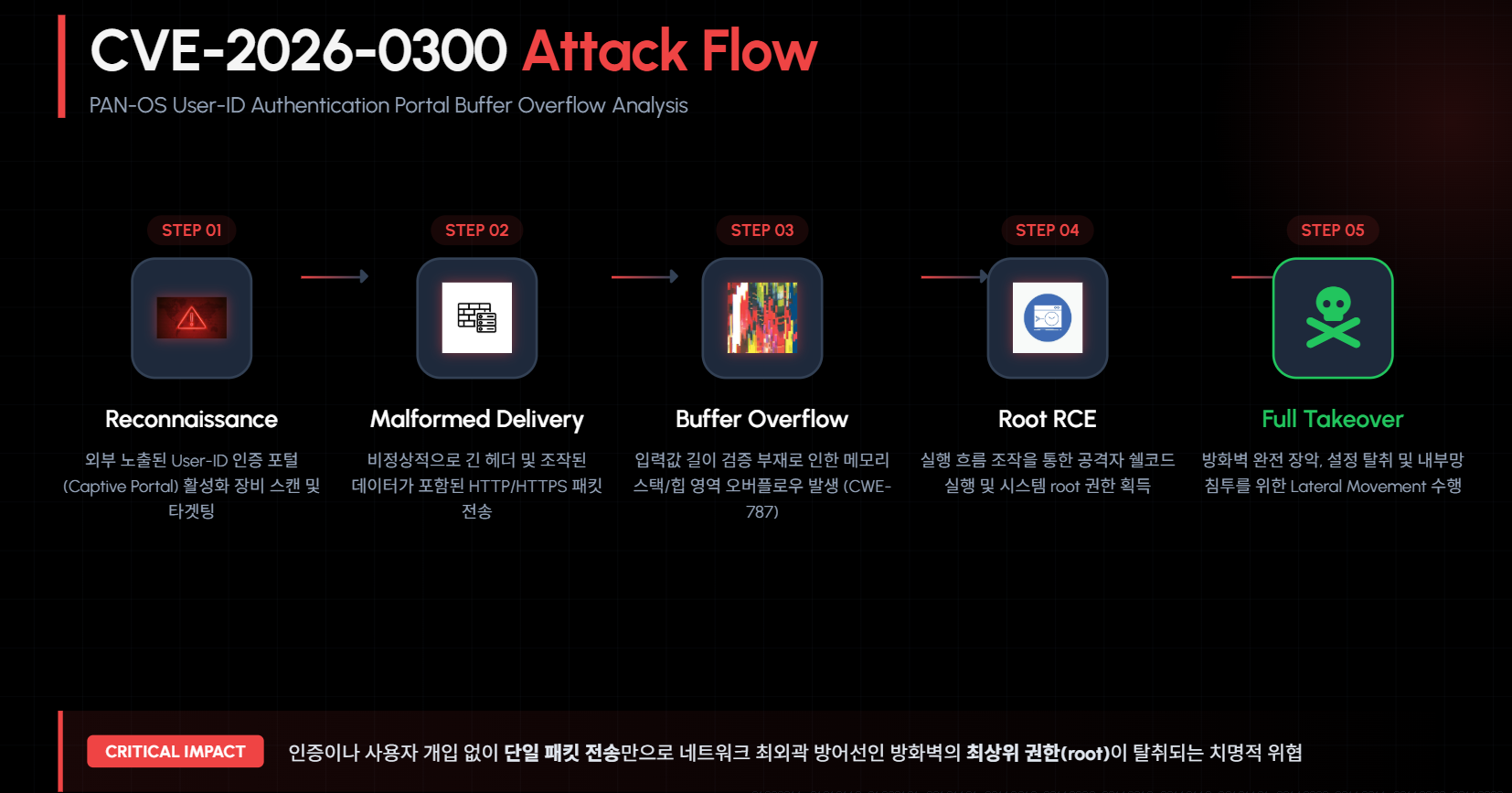
CVE-2026-0300 is a stack-based buffer overflow (Stack-based Buffer Overflow, CWE-787) vulnerability that occursbecause PAN-OS's User-ID authentication portal service fails to properly validate the length of certain incoming network packet data.
Attackers target instances where the authentication portal page is enabled on the firewall's external interface (Internet-facing) or
within untrusted zones. By continuously transmitting packets containing abnormally long headers or manipulated parameters to
the HTTP/HTTPS port where the portal service is active, the memory buffer of the internal process overflows.
This redirects the execution flow (EIP/RIP) to the attacker's injected shellcode.
- Target Selection: The attacker scans for PA-Series or VM-Series firewall appliances that are exposed to the external Internet and have the User-ID authentication portal (Response Page) enabled.
- Malicious Packet Transmission: Without requiring any login credentials, the attacker transmits a crafted sequence of packets containing a specific shellcode designed to target the authentication portal's input processing engine.
- Buffer Overflow Exploitation: As the PAN-OS portal service process parses the incoming packets, it exceeds the boundary limits of the heap/stack regions, overwriting the memory.
- Root-Privilege RCE: The attacker executes arbitrary commands with the highest system privileges (root) without any user intervention, utilizing this foothold to conduct lateral movement across the entire internal network.
Example of Attack Syntax (Conceptual Packet Structure):
POST /php/captiveportal.php HTTP/1.1

Host: [Target_Firewall_IP]

Content-Type: application/x-www-form-urlencoded

Content-Length: [비정상적으로 거대한 크기 설정]


Standard_Param=A&Malformed_Buffer_Field=[A * 8192] + [Shellcode_Payload]

<-- 입력 길이 검증 부재로 메모리 영역을 초과하여 복사되면서 root 쉘 권한 트리거 -->
3. Countermeasures & Mitigation
The CVE-2026-0300 vulnerability is a critical zero-day threat that can transform the firewall—the outermost line of networkdefense—into a launchpad for further attacks. Active exploitation has been frequently observed in the wild, prompting its immediate
addition to the U.S. CISA Known Exploited Vulnerabilities (KEV) catalog. Consequently, proactive blocking measures are urgently required.
- Immediate Patching and Upgrades: Urgent updates must be applied using the official patch versions released by Palo Alto Networks (including the latest releases such as PAN-OS 12.1.4-h5, 11.2.4-h17, 11.1.4-h33, 10.2.7-h34, etc.).
- Temporary Mitigation (Access Restriction): Until the patch can be applied, the 'Response Pages' option must be immediately disabled within the Interface Management Profile of any L3 interface connected to an untrusted external zone (e.g., the Internet). Access Control Lists (ACLs) should be adjusted to ensure the portal is accessible exclusively by users within the trusted internal network (Trusted Zone).
-
AIWAF Response: Because this vulnerability induces memory flaws at the packet level, it is essential to deploy detection rules at the Web Application Firewall layer.
- Pattern-Based Defense: Malicious packets can be blocked by applying specialized patterns that detect abnormally long parameter values or HTTP request header fields exceeding safety thresholds directed at Captive Portal-related web endpoints.
- AIWAF False Positive/Negative Minimization: Pattern scoring is currently being fine-tuned to precisely target only the "buffer overflow signature payload patterns," ensuring clear differentiation from the legitimate traffic volume and transmission values of authenticated users.
4. Conclusion
A zero-day vulnerability in a Palo Alto Networks firewall—which serves as the foundational gateway for network security—can jeopardizean enterprise’s entire corporate infrastructure with a single successful exploitation. CVE-2026-0300 is a buffer overflow flaw requiring
absolutely no user interaction, making it highly impactful despite its low attack complexity.
As detailed PoC analysis data spreads rapidly across hacking forums, comprehensive scanning and exploit attempts against vulnerable
appliances are expected to persist. Therefore, organizations utilizing these devices must immediately implement interface exposure controls,
execute temporary mitigation steps, and complete emergency firmware patching.
Our Threat Analysis (TA) team prioritizes the monitoring of remote code execution vulnerabilities targeting perimeter systems such as firewalls and VPNs.
We will maintain a proactive defensive posture through continuous signature updates for AIWAF.
5. References
- https://security.paloaltonetworks.com/CVE-2026-0300
- https://nvd.nist.gov/vuln/detail/CVE-2026-0300
- https://www.cisa.gov/known-exploited-vulnerabilities-catalog
- https://asec.ahnlab.com/ko/93664/